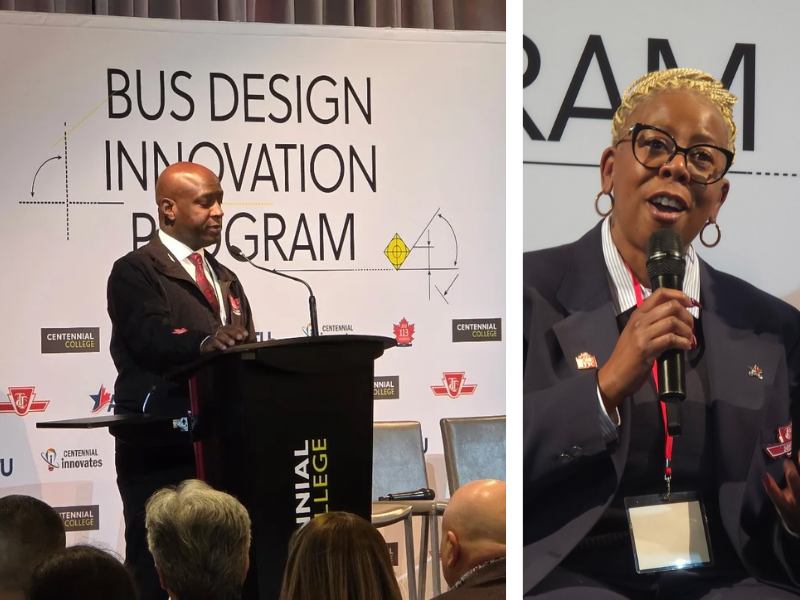
Toronto summit brings workers, transit agencies, manufacturers, and researchers together to improve operator safety
Transit safety took center stage at the Bus Design Innovation Summit at Centennial College. ATU Local 113 Health and Safety co-chairs, President Marvin Alfred, International President John Costa, the Toronto Transit Commission (TTC), and Centennial College helped lead the gathering, which focused on developing safer, smarter, and more operator-centered buses.
Through a joint labor-management partnership, ATU Local 113 showed that frontline transit workers are not merely participants in discussions about vehicle design; they are helping shape the agenda. Bus manufacturers, transit agencies, and industry experts from across North America gathered to learn about the Bus Design Innovation Program and consider how its model could influence the transit industry.
The summit advanced a clear objective: establish an industry standard that incorporates research-based, human-centered design throughout every stage of bus development. By bringing together labor, management, academia, manufacturers, and transit professionals, the partnership is translating frontline experience into practical safety improvements.
Worker Participation in Health and Safety Is Driving Change
Transit operators possess invaluable knowledge of the vehicles they use each day. Their experience helps identify effective design features, areas for improvement, and changes needed to better protect the people who keep communities moving.
- Placing transit professionals and frontline workers at the center of innovation supports safer, more effective vehicles for operators and passengers.
- Every operator deserves a workplace designed to promote safety, dignity, and confidence, with the goal of ensuring that each worker returns home safely.
- Frontline experience is essential to the development of safer, more reliable transit systems.
- Through the Bus Design Innovation Program partnership, stakeholders are working toward a global standard that makes operator protection a core requirement of every modern transit vehicle.
When workers have a meaningful voice, transit is safer and stronger for everyone.